Nakama
creating devices to help a social justice issue in the community and designing for a target user group.
Advanced Manufacturing
Social Design
Coding
Arduino
Project Description
Nakama is a handheld wellbeing device designed to support young people experiencing depression and reduced motivation, particularly in the context of increased screen dependency. The project responds to growing concerns around adolescent mental health, which have been amplified in recent years following COVID-19 and increased digital isolation.
Research informed the design direction, including data indicating that over 300 million people worldwide are affected by depression. Evidence from health organisations such as the Australian Department of Health highlights the importance of routine, physical activity, reduced screen time, and improved sleep in supporting mental wellbeing. These insights formed the foundation of the project’s design intent.
Nakama is designed as a simple, screen-based companion inspired by late 1990s and early 2000s digital pet devices. The nostalgic aesthetic was intentionally chosen to create familiarity and emotional attachment, encouraging regular engagement without overwhelming the user.
The device is built using an Arduino-based system with a minimal interface consisting of three buttons (left, right, and select). Its core function is to act as a gentle behavioural prompt, encouraging users to go outside, move their body, or take breaks from prolonged screen use. It also supports healthier sleep habits by prompting rest and enabling sleep reminders or alarms in the evening.
Overall, Nakama aims to promote small, achievable behavioural changes through simple interaction, reinforcing routine, movement, and reduced screen dependency in a non-intrusive way.
Sketching & Design Development
Developing and Prototyping
Final Protoype


The form development for Nakama focused on creating a compact, pocket-sized handheld device designed for everyday use. Early concepts explored a more square geometry, but through iteration I refined the design into a softer, rounded form that better fits the palm and improves ergonomics.
This shift prioritised comfort and approachability, reinforcing the device as a simple, accessible companion. Once the form was finalised, I produced renders to communicate the design direction and overall aesthetic.


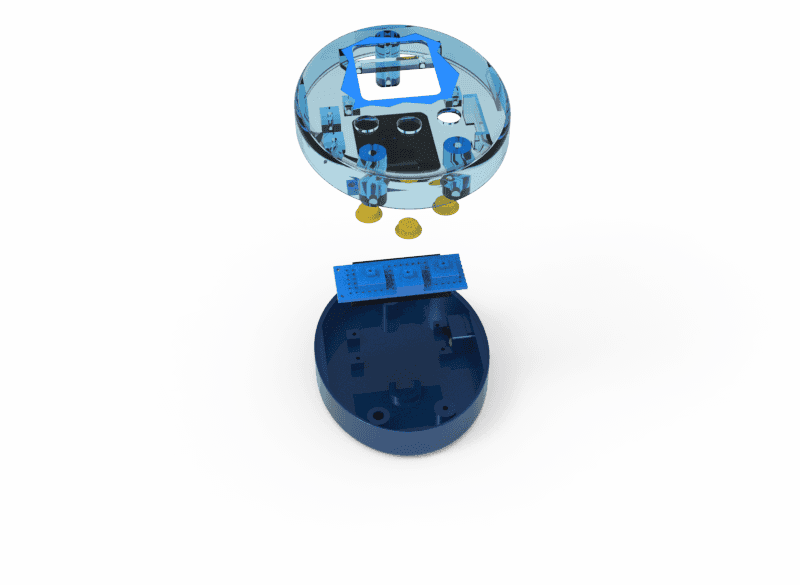


The development and prototyping phase combined CAD refinement with coding to produce a fully functional interactive device. Early prototypes included a USB-C cut-out for continuous power and easy code testing without disassembly.
The final prototype maintained full functionality, with the digital pet responding in real time to user interaction. While a custom PCB was planned, time constraints meant the final version used a breadboard system, with PCB integration intended for future refinement.


